
Documenting the unthinkable: Book recounts atrocities of Oct. 7 Hamas attack
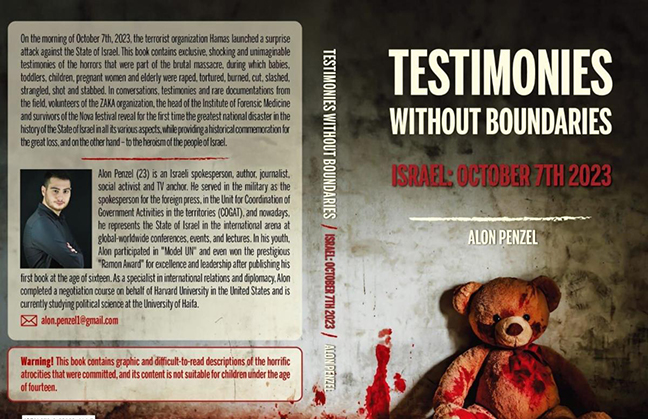
As Hamas invaded Israel on Oct. 7, Alon Penzel was a political science student at Haifa University. The grandson of a Holocaust survivor, he went to social media to defend Israel from the inevitable waves of hate.
“Already on Oct 7, I immediately foresaw the worldwide denial we would face from the international community,” he said. The only way to defeat it would be to use “unfiltered, uncensored, unapologetic historical documentation” of the atrocities that Hamas perpetrated in killing 1,200 Israelis and abducting another 251 in communities near Gaza.
After Oct. 7, Penzel said “I felt my mind is not there, I had to take a shift in my life, abandoned my studies and everything not directly related to Oct. 7.” Though not a professional historian, he set out to interview survivors, volunteers and medical officials, to meticulously document their experiences — and get their stories out as soon as possible.
The result is “Testimonies Without Boundaries, Israel: October 7th, 2023,” the first book detailing the atrocities. Completed in February, it is the result of interviews with over 60 people. With its detail of what happened on Oct. 7, it is not an easy read.
Penzel is touring the world to spread the word about the book, to counter the rampant Oct. 7 denial already present among Palestinians and their defenders on college campuses. On Oct. 8 and 9, he visited Atlanta, speaking to Jewish groups and on several college campuses.
The book is organized into five sections — testimony from ZAKA volunteers, the Forensic Medicine Institute and Nova survivors, about being human, and a statement from Israel President Isaac Herzog.
While in the military, Penzel, now 23, was a spokesperson for the foreign press in the Unit for Coordination of Government Activities in the Territories.
In his youth, Penzel participated in “Model UN” and won the prestigious Ramon Award for excellence and leadership after publishing his first book at the age of 16, “The Way Life Could Be.” As a specialist in international relations and diplomacy, he completed a negotiation course on behalf of Harvard University, and in 2022-23 was a Campus Fellow for CAMERA, the Committee for Accuracy in Middle East Reporting and Analysis.
Penzel said the interviews were difficult, because of the detail he felt needed to be shared. “Sometimes you find yourself forced to ask sensitive questions,” he said. It isn’t just that someone’s friend died, it is the need to document how it happened. “If a Zaka volunteer saw a body, how did it look like,” what was the position in relation to other family members… getting the full picture “was a difficult, emotional process.”
The goal was not to sensationalize, but to bear witness.
He said when you connect a body to who they were as “a specific person, now you know who they are, who their family is, who they are connected to… it’s even more emotional than just visualizing what happened.”
All testimonies were checked through the Israeli Police, the criminal investigation unit and the Foreign Ministry. Ones that could not be corroborated were not included.
At an event in Atlanta on Oct. 8, he shared the experiences of Natan, a rescue worker who arrived on scene days after the massacre.
He recounted entering a home that was completely destroyed, and seeing the body of a girl tied to a mattress, but could not lift her from the mattress. He and his colleagues soon discovered a man, her partner, tied to the other side of the mattress, but they both were also attached to each other through the mattress, by metal wires going through their stomachs.
Penzel said his faith in humanity was “undermined” when he interviewed Simcha Greinman, a 32-year volunteer for ZAKA, who went to the burned nursery school at Kibbutz Be’eri. There, he saw the body of a small child with a knife through its skull. Nearby was a burned hammer with pieces of a toddler’s skull.
Another ZAKA volunteer found a man who had been nailed to a door frame by a nail gun, as if he were crucified.
He interviewed Chen Kugel, director of the National Center for Forensic Medicine, who told him about a large lump of coal they received. An X-ray showed it was actually the bodies of an older woman and a young woman, hugging.
“We still don’t know everything that happened on Oct. 7,” he said. Many of the stories in the book were previously unreported and unknown to Israeli officials.
Because he wanted to reach fellow young people, as he was finishing the book he reached out to Israel-IS, which helps young Israelis tell their stories to peers around the world. A delegation of five IDF reservists with Israel-IS recently visited Atlanta, Birmingham and Nashville.
Israel-IS helped get the book published. The group’s CEO, Nimrod Palmach, had gone to the Gaza border on Oct. 7 to rescue civilians before being called up for reserve duty.
The book is already available in English and Hebrew, and he said the Spanish version was going on sale on Oct. 9. Editions in Chinese, French and Portuguese are soon to follow.
It took a while for Amazon to carry the book, though. In July, Jewish Insider reported that Amazon had rejected the book, saying it was “in violation of content guidelines.” After media inquiries, Amazon reversed its decision.
An Amazon engineer, Sasha Troufanov, is among the hostages held by Hamas in Gaza, taken from his parents’ home in Kibbutz Nir Oz. His father was murdered. Amazon has not spoken about Troufanov, with an anonymous employee last November telling the New York Post that the company feels talking about him would be detrimental, and a Globes article in June backed up that account.
In May, Palestinian Islamic Jihad released a video of Troufanov.
Israel’s Foreign Ministry and Ministry of Diaspora Affairs are purchasing large number of copies to distribute to government officials worldwide, including an effort to distribute 500 copies to government officials in China.
The Israeli embassy in Australia gave copies of the book to those who attended their Oct. 7 commemoration, with numerous copies going to government officials. On Oct. 8, Senate Opposition Leader Simon Birmingham introduced a motion to mark the Oct. 7 anniversary, citing the mattress atrocity in his speech on the Senate floor.
Next month, Penzel is scheduled to speak to the British Parliament, at a time when Britain’s new government is pulling away from Israel.
Cheryl Dorchinsky, founding director of the Atlanta Israel Coalition, said the book also goes into the concepts of survivor guilt, and anger with God. “The book answers a lot of those questions from the conversations.”
While Israel has been screening a documentary of raw footage from Oct. 7, mainly with footage filmed by Hamas, that has been in closed-door sessions around the world, often with government officials or media figures, with none of the footage allowed beyond the room. Penzel noted the book brings the reality and extent of the atrocities to everyone.
Countering denial
With the atrocity denial currently going on among anti-Israel activists, he said, “imagine what we will be facing in 50 years, 100 years.”
At George Washington University, someone approached him saying they did not support what happened on Oct. 7, but felt Israel had pre-meditated it to give Israel a pretext to commit genocide in Gaza. Penzel wondered, if a country is immoral enough to perpetrate a genocide, “why would they care about any justification?”
There have also been online reviews of the book that engage in Oct. 7 denial.
Penzel said that he has attended pro-Hamas rallies, holding an Israeli flag and the book, “interviewing people to hear what they had to say.” He said some denied the atrocities of Oct. 7, others supported it, while others “simply did not know what happened.”
He has been asked to do a book on the hostages who were liberated, but he said getting this book out was “just the beginning.” The important and more challenging part is getting people exposed to the testimonies. “That is all I care about,” he said. “Once one reads the book, they can’t just ignore it.”
He wants the testimonies to be spread “as much as possible,” out of the belief that “we owe it to the victims,” and it also shows “the basic legitimacy of Israel’s right to fight for its self defense.”


